
Most people assume language access in schools begins the day a child walks into a kindergarten classroom. It doesn't.
It starts years earlier, in rooms that don't look anything like a school — birth-to-three centers, intake offices, early intervention evaluations. Rooms where a stranger tells a parent, for the first time, that their child may need support.
We've spent the past several days in centers and schools across Chicago, and there's one room in particular we keep coming back to.
It's not a classroom. It's an evaluation room for children under three. And it's the room where the whole question of language access gets decided, long before anyone fills out a school enrollment form.
The Conversation Nobody Sees

Screenings. Intake calls. Family assessments. The first conversation where someone explains to a parent that their child may need early intervention services.
If that conversation doesn't happen in Haitian Kreyòl, the family isn't just missing information, they're being asked to consent to something they never fully understood. Everything that happens afterward is built on that shaky foundation.
Then the child turns three, and the ground shifts again. A new agency. New paperwork. The transition from early intervention into the school system.
This is the point where Haitian families most often disappear from the process, not because they stopped caring about their child's development, but because nobody spoke to them in Kreyòl at the one meeting that actually mattered.
What We Actually Do

Creole Solutions provides Haitian Creole interpretation for IFSP meetings, early intervention evaluations, IEP and 504 meetings, and parent conferences, along with written translation of the notices that go home with families. Kreyòl only. Nothing else, because that focus is what lets us go deep instead of wide.
We work onsite across Chicago and by scheduled remote interpretation everywhere else, so a district in a state where we've never set foot in the building can still get the same standard of support.
For IFSP meetings specifically, we default to video rather than phone. You're watching a child during that meeting, and you're coaching a parent in real time, a phone call loses both of those things.
And whether an interpreter is sitting at the table or appearing on a screen, it's the same named interpreter, vetted specifically for special education and early intervention terminology.
Not a general Kreyòl speaker pulled in for the day, someone who already knows what an IFSP is, what a 504 plan changes, and how to carry that meaning across the language without losing it.
A Question for School and EI Teams
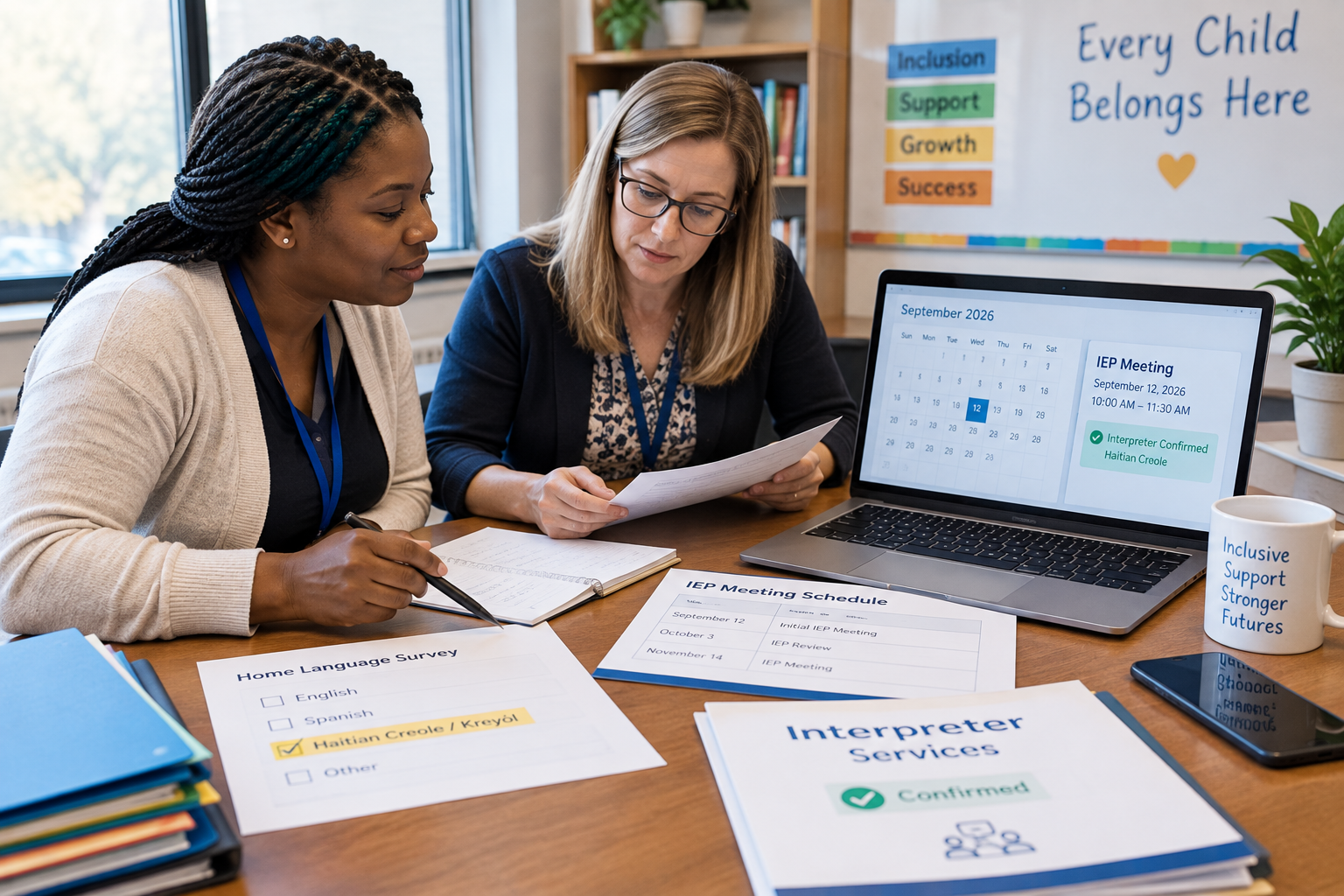
If Haitian Creole appears on your home language survey but isn't represented on your interpreter roster, that’s a gap worth addressing sooner rather than later.
Too often, organizations discover they need a Haitian Creole interpreter only when an important meeting is already scheduled.
A parent may be waiting to discuss their child’s progress, an evaluation may need to be reviewed, or an IEP meeting may be approaching, and suddenly the team is trying to find qualified language support at the last minute.
But families shouldn’t have to wait for a problem to arise before language access becomes a priority.
If you already know that Haitian Creole-speaking families are part of your school or Early Intervention community, having a plan in place before the first IEP cycle begins can make a meaningful difference.
It gives your team time to prepare and helps ensure that parents can fully participate in conversations about their child’s education, development, and support services.
Because these conversations matter.
Parents should be able to ask questions, understand recommendations, and share their concerns in a language they feel comfortable using. They should never feel like they are simply receiving information without having a real opportunity to participate in the conversation.
Language access isn't something that should be addressed only after a family has already missed an important meeting or struggled to understand critical information.
It should be part of the plan from the beginning.
If that's where your program is right now, if you know Haitian Creole-speaking families are part of your community but you're still working on building reliable language access, we'd be happy to talk.
That's exactly the kind of conversation Creole Solutions is built to have.
Frequently Asked Questions